The Shattered Paradigm — Power, Automation, and the Dissolution of Mass Sovereign Might
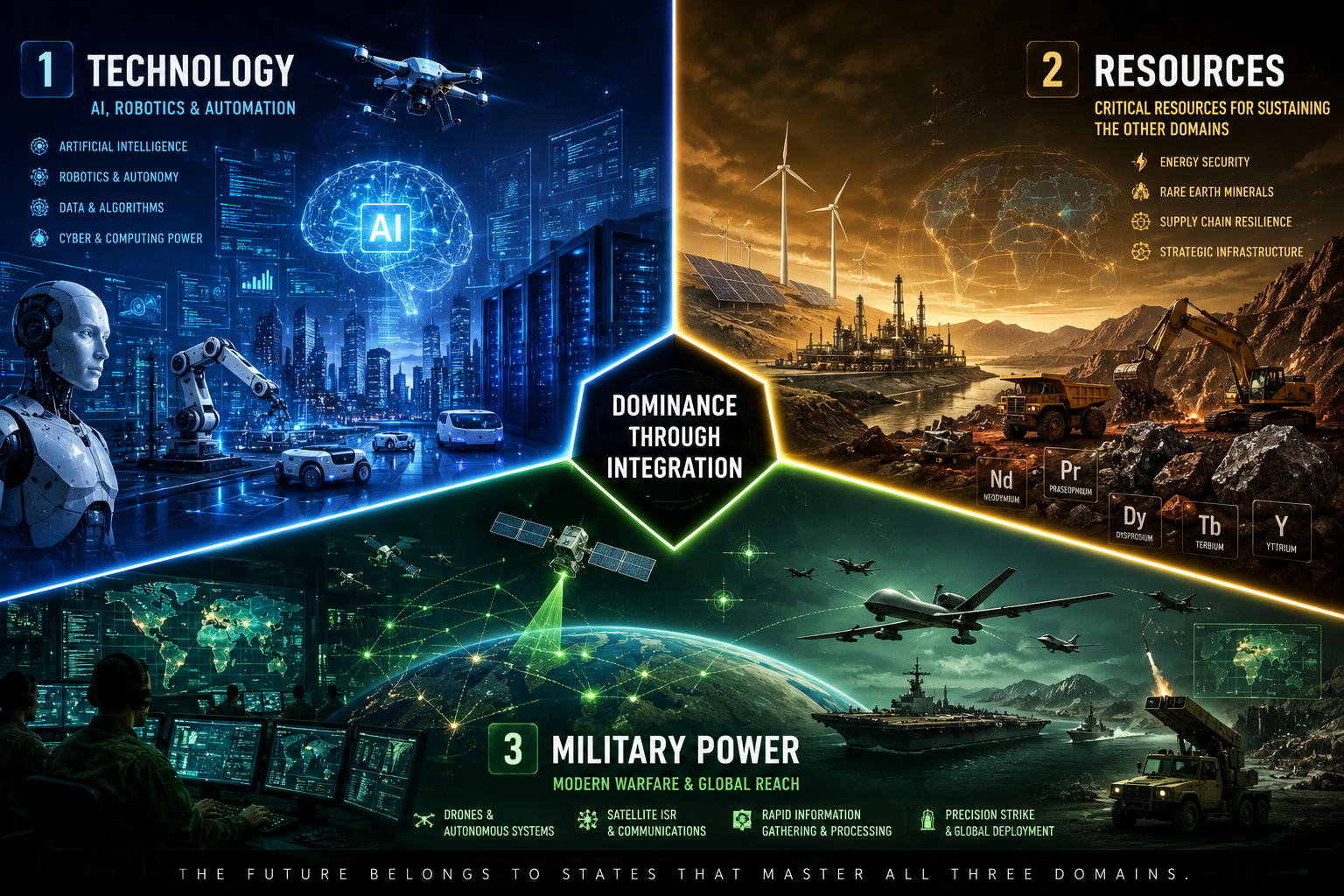
Traditional pillars of state power—mass labor, large populations, and expansive territory—are obsolete in the era of AI and high-density automation. Sovereign power now concentrates into three core domains: technological sovereignty through corporate-state partnerships, intelligence-driven control over critical mineral pipelines, and autonomous, long-range military defense that targets logistical bottlenecks. As a result, states no longer require massive workforces for economic or military dominance, shifting human capital needs toward a hyper-concentrated elite of technical talent while focusing general governance on social stability. Ultimately, future geopolitical dominance will belong to agile states that radically reorganize around sovereign compute, secure resources, and algorithmic warfare.
1. The Historical Anchor: The Quantitative State
For millennia, the grammar of geopolitical hegemony was dictated by arithmetic. To measure the strength of an empire was to count its physical components: the acreage of arable land, the millions of laborers tilling the soil, and the sheer volume of conscripts mobilized to march across borders.
In this traditional paradigm, human labor and territorial depth served as the twin pillars of sovereignty. More land yielded agricultural surplus and raw extraction; surplus supported a larger population; a larger population produced both the tax base and the mass industrial labor necessary to field expansive armies. Human beings were the primary biological engine of production, with draft animals, early machinery, and fossil fuels existing simply to amplify that biological base.
Economic cycles—from agrarian mercantilism to the industrial waves charted by classical economists—operated under the baseline assumption that growth required the mass absorption of human labor. Wealth creation, civic development, and state dominance were fundamentally bound to the aggregate size of the populace.
2. The Technological Inflection: Severing the Labor-Power Link
Civilization has arrived at a structural point of departure. Through the convergence of artificial intelligence, high-density autonomous robotics, and advanced computational networks, humanity has built systems capable of substituting not merely for muscle, but for cognitive labor, logistical coordination, and real-time strategic decision-making.
This shift severs the historical link between mass human labor and state power:
TRADITIONAL HEGEMONY
[ Territory & Mass Population ] ──► [ Industrial Output & Conscription ] ──► [ State Power ]

EMERGING HEGEMONY
[ Elite R&D + Compute/Energy ]  ──► [ Autonomous Systems & Precision ]   ──► [ State Power ]
Productivity is no longer bounded by the quantity of available workers. An automated manufacturing grid powered by modern energy sources produces more material output with greater precision and zero downtime than an entire industrial city of the 20th century. Consequently, expansive territory and massive populations cease to be direct measures of geopolitical leverage; without advanced technological integration, they become administrative overhead and strategic vulnerabilities.
3. Deep Dive into the Three Pillar Domains
I. Technological Sovereignty: Compute, Corporate Statecraft, and High-Speed Decision-Making
Power no longer resides solely in state ministries, but in the technological stacks managed by hyper-scale private corporations. We are witnessing an era where sovereign leaders directly court corporate tech giants—such as OpenAI, SpaceX, Google, and TSMC—treating them not merely as commercial vendors, but as strategic state assets. World leaders actively compete to host computational infrastructure, secure foundational AI models, and integrate low-Earth-orbit satellite coverage into national security systems.
                  ┌──────────────────────────────────────────────┐
                  │          SOVEREIGN TECH POWER                │
                  └──────────────────────┬───────────────────────┘
                                         │
        ┌────────────────────────────────┴────────────────────────────────┐
        ▼                                                                 ▼
┌───────────────────────────────────────┐ ┌───────────────────────────────────────┐
│     STATE STRATEGIC COOPERATION       │ │    ALGORITHMIC DECISION SPEED         │
├───────────────────────────────────────┤ ├───────────────────────────────────────┤
│ • State heads courting AI/tech firms  │ │ • Millisecond threat processing       │
│ • Sovereign compute infrastructure    │ │ • Automated battle management (ABMS)  │
│ • Private orbital communications      │ │ • Elimination of bureaucratic friction│
└───────────────────────────────────────┘ └───────────────────────────────────────┘
The true strategic edge lies in compressed decision cycles. A state relying on human bureaucratic deliberation cannot counter an adversary deploying AI-driven decision engines that analyze multi-dimensional sensor data, simulate scenarios, and execute kinetic or economic responses in milliseconds. Technological dominance means compressing the observe-orient-decide-act (OODA) loop until an opponent's command structure is rendered functionally static.
II. Resource Sovereignty: Critical Mineral Wars and Shadow Operations
Territory matters less for sheer surface acreage and more for access to the critical elements underpinning the high-tech economy—specifically rare earth elements (lithium, cobalt, neodymium, dysprosium) essential for AI hardware, defense electronics, and energy storage.
The global struggle over these minerals rarely manifests as open territorial conquest. Instead, top military and economic powers conduct covert, non-kinetic campaigns:
- Intelligence & Influence Operations: Deploying intelligence networks to secure extraction concessions, influence political leadership in mineral-rich developing nations, and sabotage competitor supply deals.
- Supply Chain Weaponization: Export controls, extraterritorial trade restrictions, and processing monopolies serve as economic coercion tools to degrade an adversary's military-industrial capacity without firing a missile.
- Algorithmic Allocation: Domestic resource sovereignty relies on automated real-time distribution networks that route energy, raw materials, and compute to high-priority sectors without the supply-chain friction that crippled historical planned economies.
III. Multi-Domain Defense: Drone Warfare, Operational Speed, and Maritime Logistics Interdiction
The modern battlefield has undergone a total transformation, demonstrated vividly in Ukraine. Massive traditional armored columns and static defensive positions are rendered extremely vulnerable by low-cost autonomous drones, real-time satellite telemetry, and AI-targeted precision strike networks.
                                  FORWARD EDGE
                                 (Kill Zone)
                       [Autonomous Drone Swarms / Sensor Grid]
                                      ▲
                                      │ Precision Strikes
                                      ▼
                        LOGISTICAL & MARITIME BOTTLENECK
              [Interdiction of Fuel Transports, Bridges & Shipping]
                                      ▲
                                      │ Disruption
                                      ▼
                               REAR INERASTRUCTURE
                  [Deep Drone Strikes on Energy & Logistics]
Deterrence and combat effectiveness are now governed by speed, autonomy, and logistical destruction:
- Asymmetric Drone Warfare: Small, cheap loitering munitions and networked aerial/naval drones offset vast advantages in conventional manpower and legacy heavy armor.
- Interdiction of Supply & Maritime Logistics: Modern conflict demonstrates that severing an opponent's supply lines—destroying fixed bridge crossings, hitting fuel transport corridors, or utilizing sea drones to block strategic shipping channels— Paralyzes combat units on the front lines regardless of their physical numbers. Cut the logistics flow at long range, and front-line military power collapses.
4. The Bifurcation of Human Capital
As the requirement for mass industrial labor declines, the nature of human capital transforms. Sovereign competitiveness no longer demands millions of interchangeable workers; it demands a hyper-concentrated cadre of high-level talent:
- Elite Architects: Specialized research scientists, AI theorists, quantum engineers, and chip designers who build and maintain foundational systems.
- Strategic Operators: High-level leaders shifted from routine execution to defining the strategic objective functions executed by automated networks.
For the general populace, the state's strategic imperative pivots. Where the 20th-century state invested in mass education to feed industrial labor demand, the post-labor state prioritizes social stability, civic pacification, and baseline resource provision. The vast demographic base is no longer the primary engine of sovereign expansion, but a domestic constituency to be stabilized while elite tech and military assets secure the state's global position.
5. The Horizon: The Radical State
The technologies to automate production, military force, and resource allocation are rapidly maturing, yet legacy states face a critical bottleneck: their institutional inability to adapt. Entrenched political structures, obsolete tax regimes tied to disappearing labor wages, and bureaucratic inertia leave traditional powers vulnerable.
As the gap widens between states clinging to mass-labor models and those radically reorganizing around sovereign compute, secure resource pipelines, and autonomous military systems, a new geopolitical hierarchy will emerge.
Author

Shota Kvaratskhelia
Digital creator, entrepreneur, engineer