The Post-Labor Superstar Economy
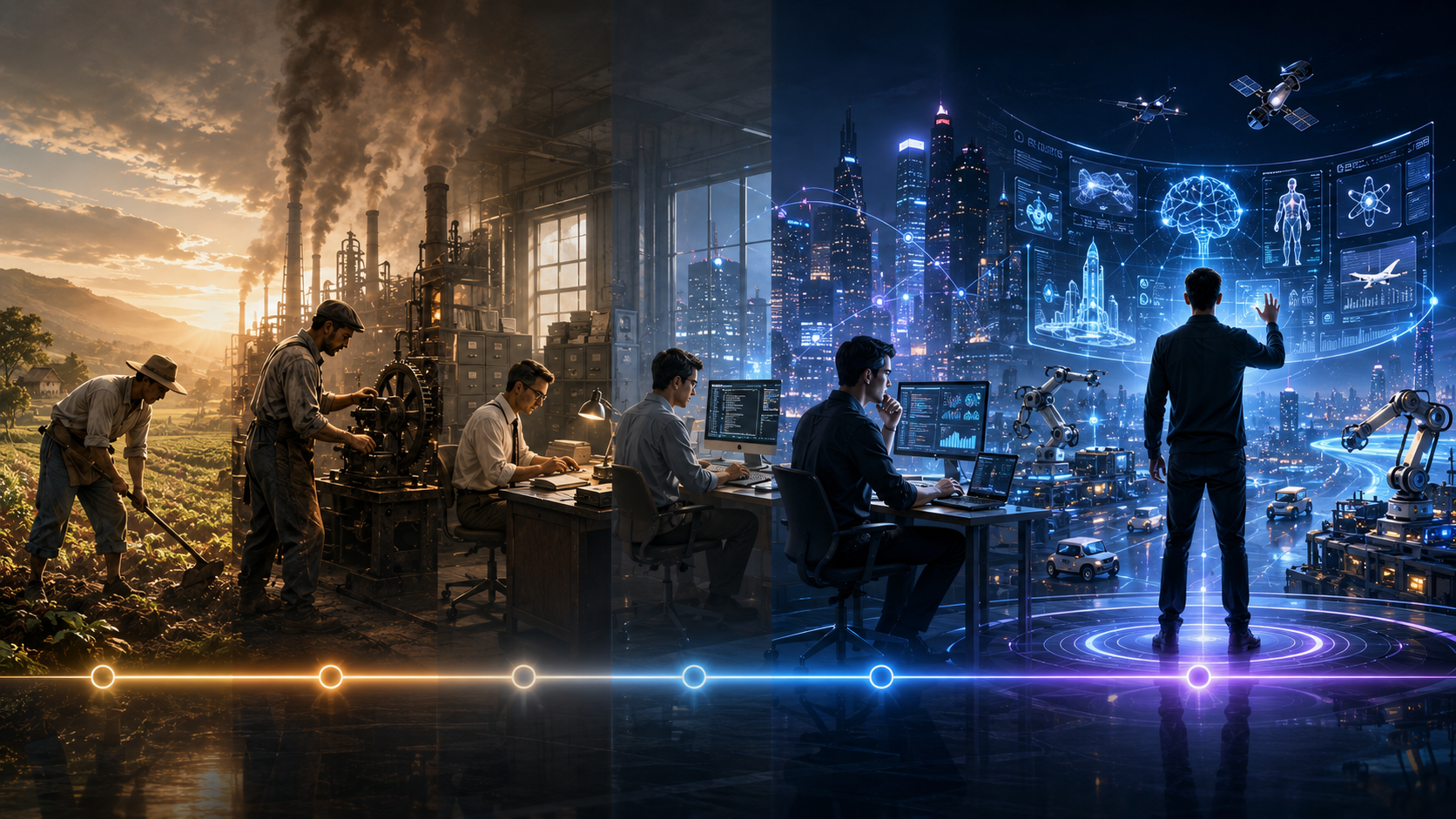
Artificial intelligence is often portrayed as a threat to jobs. But what if the real transformation is far more profound? This essay explores how AI and automation are reshaping the foundations of the global economy—not by eliminating human value, but by redefining it. From the democratization of entrepreneurship to the emergence of the **Superstar Economy**, it examines why the future may belong not to those who work harder, but to those who create, innovate, and adapt.
Introduction: A New Economic Equation
For more than two centuries, modern economic growth has been built on a simple principle: human labor is the primary engine of value creation. Every major technological revolution—from steam engines and electricity to computers and the Internet—increased productivity by making people more efficient. Although many occupations disappeared, new industries emerged, creating new forms of employment and continuously expanding the demand for human labor.
Artificial intelligence introduces a fundamentally different dynamic. Rather than simply improving productivity, it increasingly performs both physical and cognitive tasks that were once considered uniquely human. The relationship between labor, production, and economic value is beginning to change.
This transformation does not necessarily imply the end of work. On the contrary, lower production costs and powerful AI tools may enable an unprecedented wave of entrepreneurship, allowing individuals and small businesses to create products and services that were previously possible only for large organizations. The economy may become more innovative, more competitive, and far more diverse.
At the same time, the value of human labor will continue to evolve. Routine execution will become progressively less important, while creativity, scientific knowledge, engineering, leadership, entrepreneurship, and strategic thinking become the defining sources of competitive advantage.
The question facing future generations is therefore not whether artificial intelligence will replace people, but how the role of people within the economy will be redefined. Understanding this transition may prove to be one of the most important economic challenges of the twenty-first century.
Human Labor Through the Economic Cycles
Throughout history, every major technological revolution has transformed the nature of human work without eliminating its central role in the economy. The steam engine replaced much of manual labor, electricity enabled mass production, and computers automated countless administrative tasks. Each innovation displaced certain occupations while creating entirely new industries, businesses, and professions. As productivity increased, so did economic output, and ultimately the demand for human labor continued to grow.
The introduction of engineering software, accounting systems, cloud computing, and digital communication followed the same pattern. A single engineer could design more sophisticated products, an accountant could manage many more clients, and a small software company could compete with organizations that once required hundreds of employees. Rather than reducing economic activity, automation lowered the cost of creating value and allowed thousands of new businesses to enter the market.
Artificial intelligence appears to follow this historical trend, but with one important distinction. For the first time, technology is beginning to automate not only physical work but also many cognitive tasks that previously required educated professionals. If this trend continues, the relationship between productivity and employment may gradually weaken. Economic growth will continue to depend on human creativity and innovation, but it may require fewer people to produce the same amount of value.
This possibility does not mark the end of human work. Instead, it marks the beginning of a new economic cycle in which the role of labor is fundamentally redefined.
The Democratization of Production
History shows that automation rarely reduces economic activity; instead, it lowers the cost of creating it. Computer-aided design transformed engineering, accounting software enabled professionals to serve many more clients, and cloud computing allowed startups to build global products with only a handful of employees. As the cost of design, production, and management declined, new businesses emerged to compete with established incumbents.
Artificial intelligence is likely to accelerate this process on an unprecedented scale. Designing products, writing software, creating marketing campaigns, producing legal documents, analyzing data, or developing business strategies can increasingly be completed in hours rather than weeks. The resources once required to build a competitive company continue to shrink, allowing individuals and small teams to enter markets that were previously inaccessible.
The film industry provides a compelling example. Producing a high-quality movie has traditionally required hundreds of specialists, expensive equipment, and substantial financial investment. AI-powered production tools may soon enable independent studios to create cinematic-quality films with only a small creative team, dramatically reducing both production time and cost. Similar changes are beginning to appear in software development, industrial design, education, healthcare, architecture, and many other industries.
The most significant consequence may not be fewer products, but far more of them. As barriers to entry continue to decline, the global economy is likely to become increasingly populated by specialized businesses creating highly customized products and services for narrowly defined markets. Automation, in this sense, does not reduce competition—it democratizes it.
The Rising Cognitive Threshold
The greatest challenge of the AI economy may not be job displacement itself, but the steadily increasing intellectual capabilities required to create economic value. Artificial intelligence is a powerful tool, but it still depends on human direction. Someone must define objectives, generate ideas, organize complex tasks, evaluate outcomes, and make strategic decisions. As routine execution becomes increasingly automated, the human role shifts toward creativity, judgment, and orchestration.
This transition will not be equally easy for everyone. A significant share of today's workforce is employed in occupations based on repetitive physical or administrative work, including manufacturing, retail, transportation, agriculture, and many service industries. Moving from routine execution to creative problem-solving requires new knowledge, continuous learning, and a different way of thinking.
At the same time, human labor will remain essential in many sectors. Construction, hospitality, healthcare, elderly care, education, and numerous skilled trades rely heavily on adaptability, interpersonal relationships, and real-world judgment, making full automation either technically difficult or economically impractical. In many cases, employing people will continue to be more efficient than deploying sophisticated robotic systems.
The future economy will therefore demand fewer routine workers and more individuals capable of creating, directing, and improving intelligent systems. The defining competitive advantage will no longer be the ability to perform repetitive tasks, but the ability to imagine new possibilities and transform them into reality with the assistance of artificial intelligence.
Education for the AI Era
If the AI economy increasingly rewards creativity, scientific thinking, and exceptional performance, then education must evolve accordingly. For more than a century, education systems were largely designed to prepare people for standardized industrial work, emphasizing memorization, routine problem-solving, and specialization. These skills aligned well with the needs of factories, large corporations, and bureaucratic organizations.
The next generation will require a different foundation. Technical literacy, engineering, mathematics, and computer science will become increasingly important, but technical knowledge alone will not be enough. Creativity, entrepreneurship, communication, critical thinking, interdisciplinary learning, and the ability to collaborate effectively with intelligent systems will become equally valuable. Future professionals will spend less time performing routine tasks and more time defining problems, evaluating solutions, and making strategic decisions.
Perhaps the most important skill will be the ability to learn continuously. As artificial intelligence accelerates technological progress, knowledge will become obsolete more quickly than ever before. Individuals who continuously adapt, acquire new skills, and embrace emerging technologies will be far better positioned than those who rely solely on formal education completed early in life.
The objective of education will therefore shift from preparing people for a single profession to preparing them for a lifetime of continuous adaptation, innovation, and collaboration with increasingly intelligent machines.
Conclusion: Human Value Beyond Labor
Every major technological revolution has transformed the economy while preserving the central role of human labor. Artificial intelligence may become the first to fundamentally redefine that relationship. Rather than simply making people more productive, it increasingly enables machines to perform both physical and cognitive tasks, changing how economic value is created.
This transformation should not be viewed solely as a threat. Lower production costs, intelligent automation, and accessible AI tools are likely to democratize entrepreneurship, accelerate innovation, and enable individuals and small businesses to compete on a global scale. At the same time, the value of routine work will continue to decline, while creativity, scientific discovery, engineering, leadership, and entrepreneurship become the defining drivers of prosperity.
The emerging economy may therefore become a superstar economy, where intelligent systems amplify the productivity and global reach of exceptional individuals. Success will depend less on the number of hours worked and more on the ability to generate original ideas, solve complex problems, and continuously adapt to technological change.
The post-labor economy is not the end of human work. It is the beginning of a new chapter in which human value is measured not by routine execution, but by imagination, judgment, innovation, and the ability to create what machines cannot.
Author

Shota Kvaratskhelia
Digital creator, entrepreneur, engineer